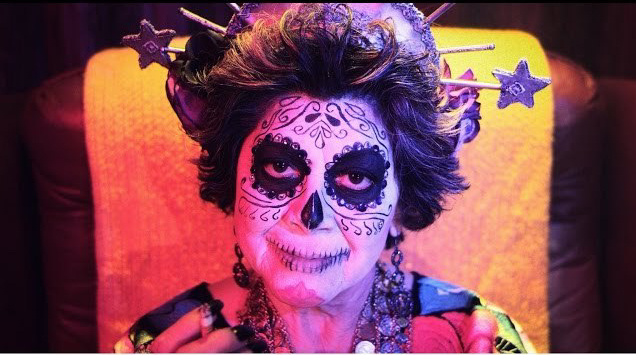
The first movie, Mexico Barbaro, consists of eight short films each created by a different Mexican director that re-tell some of Mexico’s most terrifying folk-tales and legends. What was interesting about this movie was the format, one full-length movie comprised of eight mini-movies, this was a fresh take from the typical movie format. Also, it was interesting to see the director’s take old folk-tales and legends and use new technology to make these stories come to life in shocking realism. I also appreciated each director’s unique artistic style to their movies. The stories themselves included tales of the boogeyman, trolls, ghosts and other evil spirits, monsters, a take on Día de los Muertos, and even Aztec sacrifices. Although gruesome and unsettling, this movie truly was an explosion of Mexican culture, history, and traditions. Each movie brought something to the table, however my personal favorite was the last movie in the sequence entitled Día de los Muertos. Día de los Muertos (“Day of the Dead”) is an actual holiday celebrated in Mexico with the purpose to honor and celebrate loved ones who have passed on. However, in this movie that director adds a sinister twist to the holiday. The movie starts out with a Madame instructing her “girls” to prepare for a night of work. It appears that the women are part of a human trafficking ring and are forced to perform at some seedy bar. The women were instructed to paint their faces as sugar skulls in honor of Día de los Muertos before going to work. Now at the bar, the women are instructed to seduce these grimy men hanging out. But then there is a turn in events, these seemingly entrapped women are actually ghosts of the men’s pasts who were raped, abused, or left for dead. This is now a story of vengeance and justice. In the end the women dominate the men and kill them while their Madam sits back and watches the whole affair with a smirk on her face.

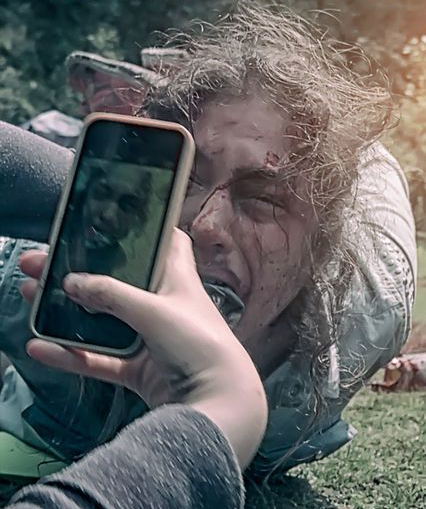
The second movie, Romina, was about a group of friends who go on a camping trip in the woods. The camping site is empty except for one other girl staying there by herself. We don’t see the other person staying at the camp site for a large chunk of the movie and then there is a scene where one of the guys from the group of friends at the camp site goes off to find firewood. While in the search for firewood the guy comes across the girl staying by herself at the site, Romina. Romina happens to be swimming nude in the lake and the guy is creepily peeping on her from behind a tree. While this is happening, back at the camp site the rest of the friend group starts to wonder where he is so one other guy goes looking for him. Soon the guy finds the missing friend, seeing him spying on this girl. After some thought the guy who had been leering at the girl for some time snuck up on her and raped her with the help of his friend as lookout. After, the guys go back to their campsite and go to bed thinking they will run out in the morning. However, by morning everything has changed, a story of revenge now breaks through. The group of friends wake up to find their car destroyed so they cannot drive away. Now the group starts to panic. Besides the rapists, the rest of the group is wondering what happened and consequently starts to freak out. The main rapist suddenly disappears, and then other people start disappearing in pairs as well. In the end everyone has been killed in a torturous and gruesome manner except for one guy who surprisingly was in on the attack and also happened to be Romina’s boyfriend.
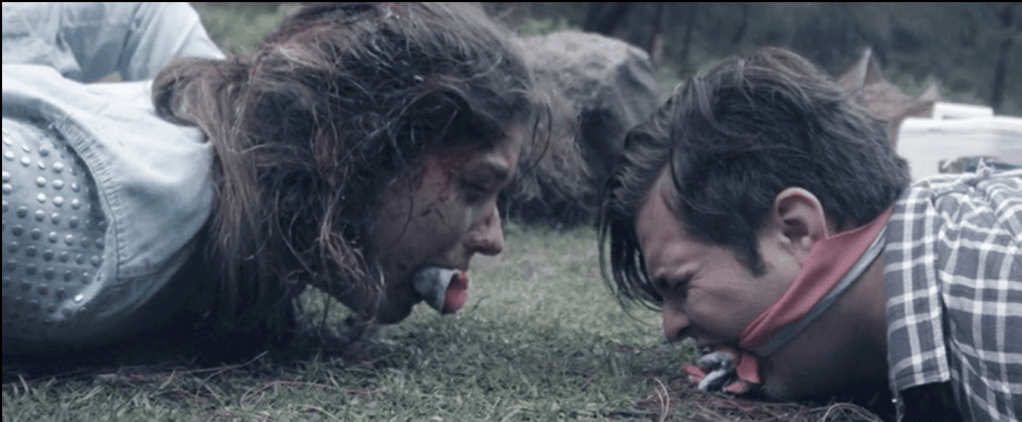
There were multiple similarities (emics) portrayed in both movies. For starters both movies were gory, and both movies had twists that came as a definite surprise. This may not be a legitimate emic, but from what I have observed it seems as though revenge is a popular topic among Mexican films, but then again it could just be a coincidence. Interdependence was highly exemplified throughout both movies, there was a sense of teamwork between characters. In Día de los Muertos, the ghosts worked together as a team to take revenge on the men who hurt them. In Romina, the friend group that was getting targeted would generally stick together in pairs and try to help each other out when being attacked by Romina. Also, even though the audience could not know this until the end, Romina’s boyfriend (who was part of the friend group) was working with her the whole time so Romina’s plan for vengeance relied upon a relationship and not her own doing. The setting and imagery in both movies were interesting to see. In Día de los Muertos, there were numerous settings ranging from the desert to the city, it was interesting to see how diverse Mexico’s landscape could be. All in all, I found both movies to be quite interesting, however I particularly favored Barbarous Mexico because I got to experience more aspects of Mexico’s culture. On a scale of 1-10 (1 being least scary and 10 being most scary) Barbarous Mexico is a 4 and Romina is a 3 in my opinion.

 Olivia's Blog